from cosmos
to quantum.
The portrait video plays on an approved Vimeo domain.
Small particles. A big question.
Could the Quran’s “pairs” reach into quantum physics?
Three consecutive verses move from the sky, to the Earth, to pairs in creation. Could that invitation to reflect take us all the way down to the building blocks of matter?
Start with the universe. The episode connects the sky’s expansion with a changing cosmos.
Look beneath our feet. The spreading Earth brings moving plates and new ocean floor into view.
Then think smaller. Particles and antiparticles offer a striking example of pairing in nature.
The idea in one picture
Same mass. Opposite charge.
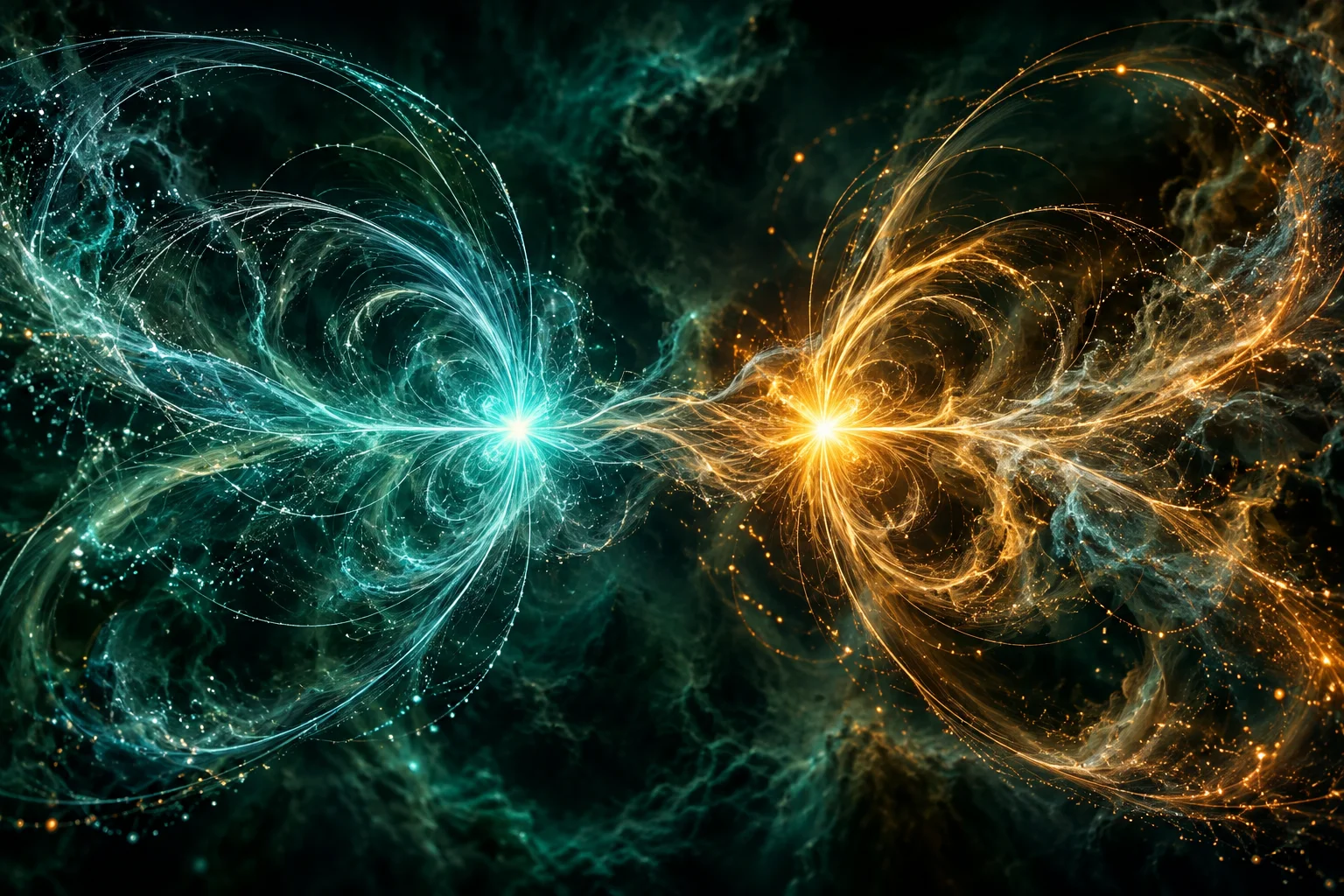
AI-generated conceptual illustration · colors and light trails are artistic
The positron is the electron’s antimatter counterpart. The episode brings this pairing into conversation with the Quran’s invitation to reflect on pairs throughout creation.
Three verses. Three scales.
From the vast to the very small.
The episode proposes a connected reading of Quran 51:47–49. Open an idea to explore it.
01Could the sky’s expansion evoke an expanding universe?The largest scale · 51:47
The episode reads the language of building and expanding the sky alongside modern cosmology. On the largest scales, space is expanding, increasing the distances between faraway galaxies.
Observations also show that this expansion is accelerating. “Dark energy” is the name given to whatever accounts for that acceleration; its nature remains an open question.
02What might a spreading Earth bring to mind?The world beneath us · 51:48
The next verse describes the Earth as spread out. The episode connects that image to a world whose surface is continually reshaped by moving tectonic plates.
At mid-ocean ridges, molten rock rises and cools to form new oceanic crust. This crust moves away from the ridge in a process called seafloor spreading, while older crust is recycled elsewhere through subduction.
03Could “pairs” include the building blocks of matter?The smallest scale · 51:49
وَمِن كُلِّ شَيْءٍ خَلَقْنَا زَوْجَيْنِ لَعَلَّكُمْ تَذَكَّرُونَ
The verse speaks of pairs throughout creation and invites reflection. The episode extends that reflection into physics: an electron and a positron, positive and negative electric charge, and the related up and down quarks.
These examples make the question compelling: could the language of pairs invite us to look beyond familiar opposites and into the structure of matter itself?
A little deeper
More to explore, if you’re curious.
How do waves and particles fit into the story?
Light and electrons can show wave-like patterns and particle-like interactions. Wave-particle duality describes these complementary aspects of a quantum entity. The episode includes this as another way to think about duality in nature.
Could there be more particle partners to discover?
Supersymmetry proposes additional partners for known particles. It remains an unconfirmed theory, giving physicists another possible pattern to investigate.
What about balance on a cosmic scale?
Gravity draws matter together into structures, while the universe expands on large scales. The episode reflects on this interplay as another example of contrasting tendencies in nature.
Dark matter contributes to gravitational structure; dark energy is associated with accelerated expansion. Here the connection is one of cosmic balance, rather than a particle–antiparticle pairing.
Episode summary, sources & illustration notes
The episode follows three verses from the cosmos to Earth and then to quantum pairs. It explores how modern physics and geology can enrich reflection on their language. This page is an edited summary based on the original episode page.
- Watch the episode on Vimeo.
- Quran 51:47–49: text, translations, and commentary. English descriptions here summarize the passages.
- Science sources: CERN on antimatter, CERN on supersymmetry, NASA on dark energy, and USGS on seafloor spreading.
- The AI-generated particle illustration uses color and light trails to visualize a pair. It is conceptual artwork, not a detector image or a depiction of particle shape, size, or measured paths. Related-episode artwork comes from the site’s existing images.
Follow the story