Two scales.
One mystery.
The portrait video plays on an approved Vimeo domain.
Six-Day Mystery & the 10 Quintillion Miracle
Six days of creation.
Whose clock?
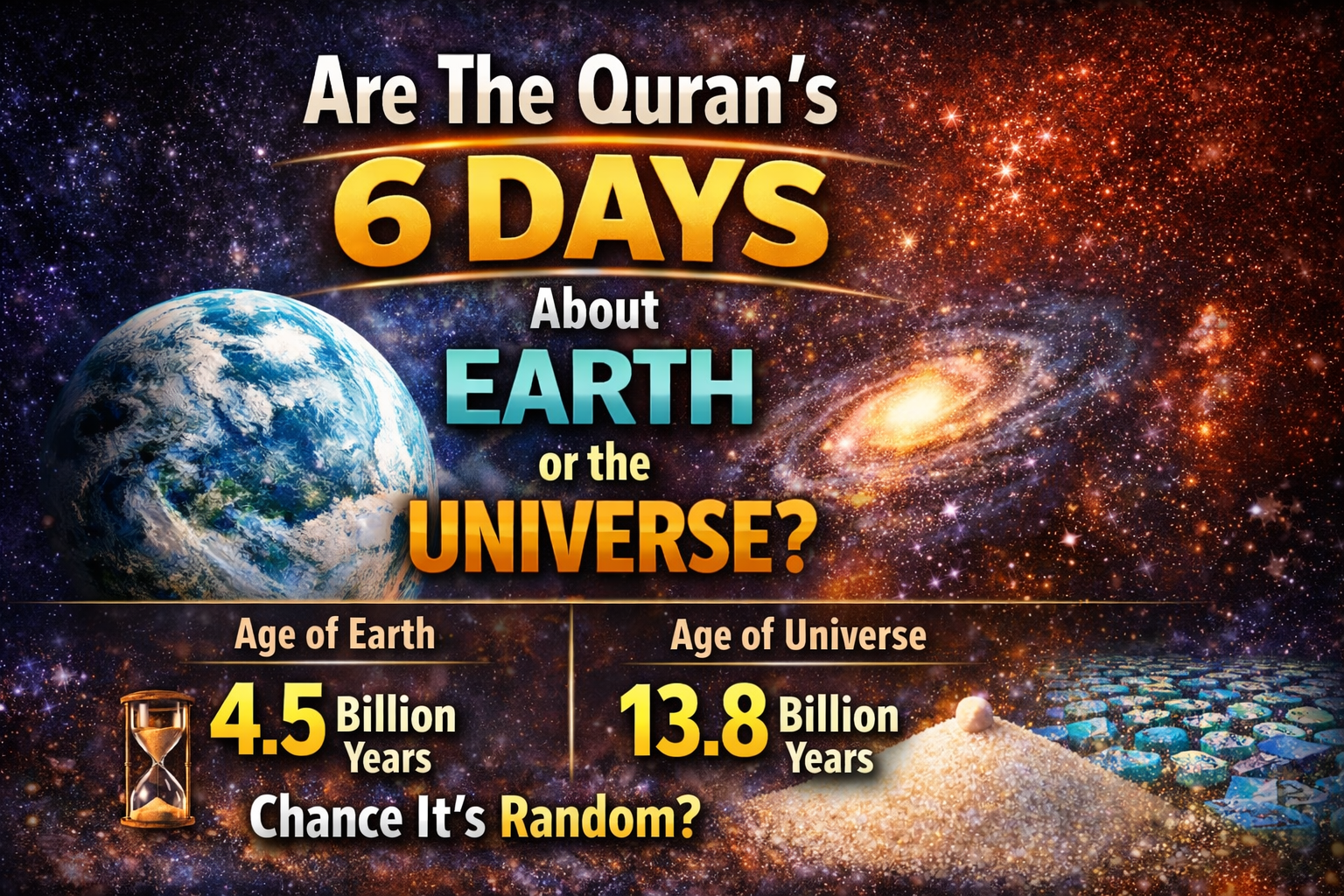
The universe and Earth began billions of years apart. Could the Quran’s six days describe both—using a different scale of time in each setting?
One framework, two scales. The episode explores creation at the scale of the universe and the Earth.
A day can mean more. Quranic passages place a day alongside spans of thousands of years.
A pattern worth exploring. The episode connects these time references to a mathematical model and a striking probability estimate.
First, the scale of time
Earth arrives much later in the story.
That difference is the starting point of the episode: if “six days” can describe more than one setting, perhaps the length of a day depends on the context.
Follow the question
What could those six days mean?
01Could the same framework describe Earth and the universe?One phrase, different settings
The Quran describes the creation of the heavens and Earth in six days, including in 7:54. Other passages draw attention to particular aspects of creation.
The episode reads cosmic descriptions alongside the Earth-focused language of Surah Fussilat 41:9–12, with its mountains and sustenance. It proposes that the six-day framework can apply at different scales, with the surrounding passage guiding the reading.
The central idea is flexibility: the same number of periods can describe very different spans of time.
02How long is a “day” in this reading?From everyday time to immense periods
The episode treats the creation days as extended periods. Quranic references to a day and 1,000 years, and to a day of 50,000 years, provide its starting point for thinking beyond an ordinary daily cycle.
For a simple sense of scale, dividing 13.8 billion years into six equal parts gives 2.3 billion years per part. Dividing 4.55 billion years by six gives about 758 million years per part.
These are illustrative averages using the ages above; the episode’s interpretation allows periods of different lengths.
03Could the time references form a larger pattern?1 day · 1,000 years · 50,000 years
The research takes three values—one day, 1,000 years, and 50,000 years—and expresses them in a common unit. It then examines their relationships on a logarithmic scale, a way to compare numbers that differ enormously in size.
The episode presents a scaling model whose projected values align closely with Earth and universe timescales. It describes simulation testing to explore how often such an alignment would arise within the model’s random comparisons.
The number behind the title
How big is 10 quintillion?
The episode’s reported estimate
1 in 10 quintillion
1 in 10,000,000,000,000,000,000
The episode reports odds as low as this for a chance alignment under its mathematical model.
Explore the calculation →Picture one grain of salt among 10,000 pools of sugar.
The video offers an analogy: imagine 10,000 Olympic-sized swimming pools filled with sugar, with just one grain of salt hidden among them. Then imagine choosing that grain on the first try.
The analogy uses roughly a quadrillion sugar grains per pool to illustrate the size of the reported number.
What does the probability refer to?
It refers to the numerical alignment tested by the episode’s model. The video reports more than 30 billion simulation trials and an estimate as low as one in 10 quintillion.
The research paper is the place to examine the comparison rules, assumptions, and how the estimate is derived. The figure here is the episode’s reported result.
For the curious reader
Keep exploring.
Read a short episode summary
The episode asks whether the Quran’s six days can describe creation at both cosmic and Earth scales. It draws on different Quranic time references to propose that a “day” can represent immense spans of time.
It then connects that reading to a mathematical model of day-related values, presenting a reported probability estimate through the image of one salt grain hidden among thousands of pools of sugar. This is an edited summary based on the original episode page.
Sources & visual notes
- Six-Day Mystery & the 10 Quintillion Miracle: the episode’s interpretation and reported probability.
- Research page and paper on Zenodo: the proposed mathematical model.
- Quranic passages: 7:54, 41:9–12, 22:47, and 70:4. English descriptions are summaries.
- NASA: the age of Earth and the universe. The age bars show the approximate timescales used on this page; they do not depict the model’s fitted periods.
- Related-episode images come from the site’s existing artwork.
Follow the story